
Three things happen: a product's declaration is resolved, it is shown on the product page, and when an order is placed it is frozen onto each order line. A report shows what is missing.
The fields
| Field | Product meta key | Free | Full edition |
|---|---|---|---|
| Manufacturer | _gmpc_manufacturer |
✓ | ✓ |
| Responsible person | _gmpc_responsible |
✓ | ✓ |
| Importer | _gmpc_importer |
✓ | |
| Distributor | _gmpc_distributor |
✓ | |
| Safety information | _gmpc_warnings |
✓ | ✓ |
| Conformity documents | _gmpc_documents (list of attachment ids) |
✓ |
Text fields are sanitised as plain text with line breaks kept, both when saved and when shown. Documents are attachment ids from your media library, never typed URLs.
Resolution: which declaration a product has
Free edition
The product is the record. The declaration is exactly the three fields typed on the product's Compliance tab. A variation uses its parent product's fields.
Full edition
For each request the plugin:
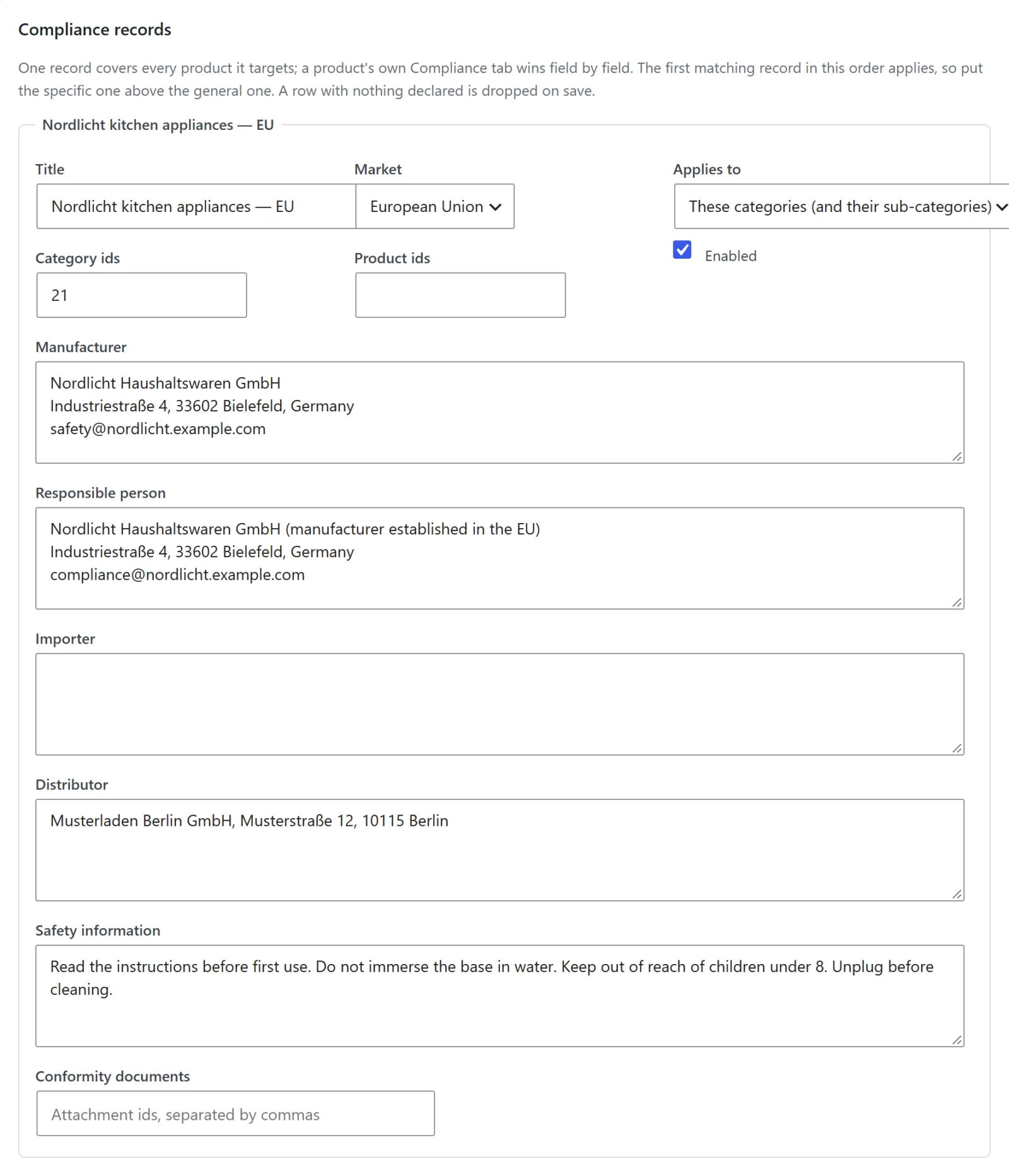
- Reads the product's own six fields (a variation reads its parent's).
- Works out the shopper's market (below).
- Walks the enabled records for that market — a record for "every market" counts for both — in the order they appear on the settings screen, and takes the first one that covers the product:
- Every product covers everything;
- These products covers the listed product ids (the parent id, for a variation);
- These categories covers a product in a listed category or in any sub-category of one.
- For every field the product left empty, takes the record's value.
- Passes the result through the
gmpc_declarationfilter.
So the product wins field by field: a product with its own warnings and nothing else typed shows its own warnings and the record's manufacturer, responsible person and the rest.
Two consequences:
- Only one record fills gaps. If the first matching record has no importer, the product shows no importer, even if a later record has one.
- Nothing is invented. A field neither the product nor its record fills stays empty and is simply not shown.
The same resolver answers the product page, the tab, the order copy and the report, so they always agree.
Markets
Full edition. The market is uk or eu:
- the customer's shipping country, else
- their billing country, else
- your store's base country, else
- the fallback set in the settings.
A country of GB gives uk; any other country gives eu. The gmpc_market filter can change the answer, but only to eu or uk.
Where it is shown
The declaration prints on WooCommerce's woocommerce_single_product_summary hook at priority 25. On a classic product page that is after the short description (20) and before the add-to-cart form (30). On a block theme, WooCommerce's compatibility layer fires the same hook where the Single Product template's summary blocks are, so the position follows your template.
It is a short list headed Product safety and compliance, showing only the fields that have a value; conformity documents are links that open in a new tab, by their media-library titles (a deleted attachment simply disappears). The guarantee text, if set, follows the list.
Nothing is printed when the switch is off, or when the product declares nothing and there is no guarantee text. The stylesheet loads only on pages where a declaration was drawn. There is no storefront JavaScript.
Full edition: with the tab setting on, a Product safety tab (priority 35 among WooCommerce's tabs) shows the same list, in addition to the summary.
Only single product pages show the declaration; shop archives and the cart do not.
Frozen onto the order
When an order is created at the checkout — WooCommerce fires woocommerce_checkout_create_order_line_item for the classic checkout and for the Store API that the Cart and Checkout blocks use — the plugin resolves each line's declaration and stores it on the order line item under the meta key _gmpc_declaration, written once.
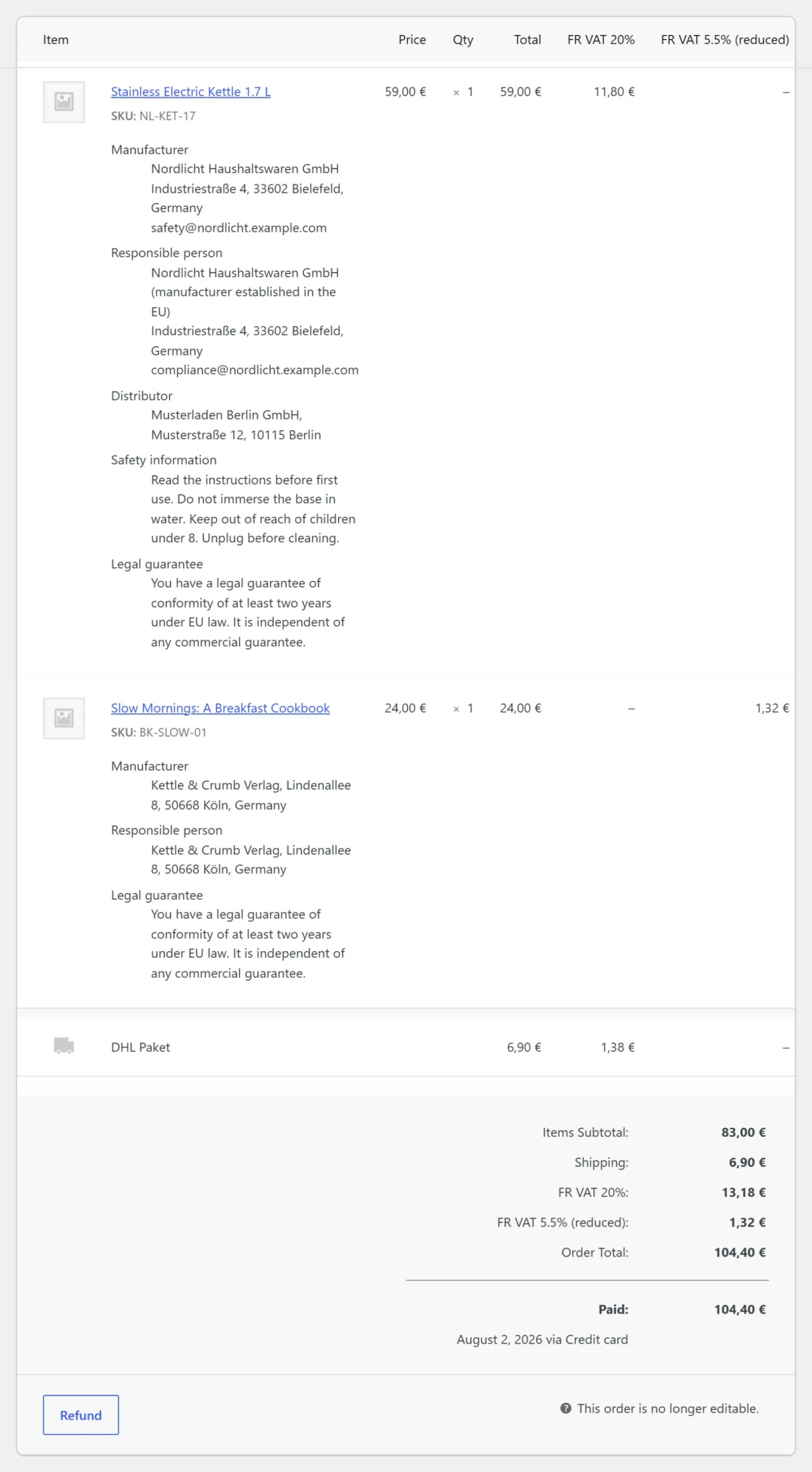
What is stored:
- the text fields, as resolved at that moment;
- Full edition: documents as their title and URL at that moment, so the record does not depend on an attachment id that can later be deleted or replaced;
- the guarantee text (drawn back under the label Guarantee);
- Full edition: the market (
euoruk) the declaration was resolved for; frozen_at, the time in UTC.
A line whose product declares nothing, with no guarantee text set, gets no copy.
The copy is drawn back — read from the line, never worked out again — under the item on:
- the admin order screen (
woocommerce_after_order_itemmeta); - the order-received page, My Account's order view and WooCommerce's order emails (
woocommerce_order_item_meta_end).
Editing a product or a record afterwards changes nothing on existing orders.
Not frozen: orders created by hand on the admin order screen, or through the REST orders endpoint, do not go through the checkout and get no copy.
Across editions: both editions use the same key. The free edition draws a line frozen by the full edition in full — importer, distributor and documents included — because it is a record of the sale.
The report
The Products that need a responsible person card reads published simple and variable products a page at a time, ordered by id, resolves each one exactly as above (records included in the full edition) and lists those with no responsible person and no manufacturer established in the EU. A product whose manufacturer's address ends in an EU member state is not listed: a manufacturer established in the EU is itself the economic operator the GPSR asks for, and the separate responsible-person line applies only when the manufacturer is outside the EU. The plugin reads only the last line or comma-separated part of the address, and recognises the 27 member states by their English names and their own ("Germany" or "Deutschland") — never by two-letter codes, since DE is also Delaware. "Northern Ireland" counts as the United Kingdom. When it cannot tell, the product stays on the list. Caps: 200 products (free), 500 (full edition).
What the plugin never does
- It does not check whether the information is correct or whether a responsible person is properly appointed.
- It makes no external request for any of this; everything is in your database and media library. (The full edition contacts gatemi.com only for licensing and updates, and only once a license key is entered.)
- Uninstalling removes the settings (and, in the full edition, the records and license state), but never a product's declaration or a declaration frozen onto an order.