
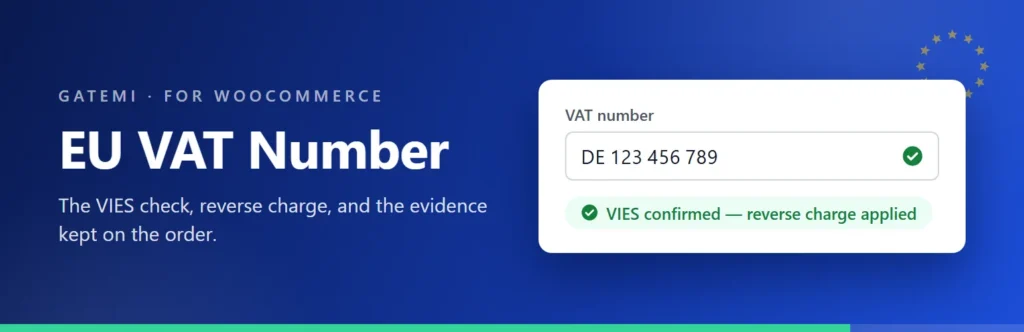
A valid VAT number from your own country does not remove VAT. Why domestic B2B sales are still taxed, and how shops get this wrong.
Here is a mistake that costs shops real money and looks completely normal while it happens: a business customer in your own country enters a valid VAT number at checkout, and the VAT comes off.
It should not. In the general case, a sale to a business in your own country is taxed at your own rate, VAT number or not.
Not legal or tax advice. Some countries have special domestic reverse-charge rules for particular goods or sectors. Ask your accountant whether any apply to you.
Why the VAT number does not change a domestic sale
The EU reverse charge and the goods exemption both exist for cross-border sales. Look at what each one needs, in the VAT Directive:
- Goods — Article 138 exempts a supply when the goods are dispatched or transported to another member state, to a buyer identified for VAT in a member state other than the one the goods leave. Goods that stay in your country do not qualify.
- Services — Article 196 makes the customer liable for the VAT when the service is taxed in their country (under Article 44) and the supplier is not established in that country. If you and your customer are in the same country, you are established there, so this does not apply.
The normal rule — Article 193 — is that the supplier pays the VAT. The reverse charge is an exception to that rule, and a domestic B2B sale is not inside the exception.
The Commission's own explanation on Your Europe is framed the same way: you do not charge VAT when selling goods to a business in another EU country with a valid VAT number, and the goods go to that country.
A domestic business customer usually recovers the VAT you charged as input tax on its own return. Charging it is not a cost to them; not charging it is a cost to you.
How the mistake happens
Most of the time it is a plugin that asks only one question: is this VAT number valid? A valid number from your own country passes. So does a valid number from anywhere. The VAT comes off.
Nothing at the checkout looks wrong. The customer is happy. The number really is valid. Your order screen may even say "VIES confirmed this number." The problem appears when your accountant reconciles the quarter and finds a stack of domestic sales with no VAT on them — VAT you still owe.
Two smaller versions of the same mistake:
- Comparing against the wrong "home". If your plugin has its own "my country" box and it disagrees with your WooCommerce store address, you can end up exempting your own customers. A sensible default is to take your country from the store address.
- Not checking the number's country at all. A customer in your country who gives a valid number from a different country also gets the VAT off, if the plugin compares nothing.
A worked example
Brouwer Koffie is an example shop in the Netherlands. Assume, for the arithmetic, a 21% standard rate.
An office in Utrecht orders €1,000 of equipment and gives a valid Dutch VAT number.
- Correct: €1,000 + €210 VAT = €1,210. The office reclaims the €210 on its own return.
- The mistake: €1,000, no VAT. Brouwer still owes €210 to the Dutch tax authority, and has to either absorb it or go back to the customer and re-invoice.
Ten such orders a month is €2,100 a month of VAT nobody collected.
How the Gatemi plugins handle it
Both editions refuse to exempt a customer in your own country by default.
- Your country is taken from the plugin's "Your country" setting, or — if you leave it empty — from your WooCommerce store address.
- The exemption needs four things: a number VIES confirmed, a number whose prefix matches the billing country, a billing country that is not your own, and the feature switched on.
- When the first two pass but the customer is in your country, the VAT stays on and the order records "Tax was charged on this order."
Gatemi EU VAT Number (free) never exempts your own country — there is no setting that changes that.
Gatemi VAT Number for WooCommerce (full edition) has a setting, "Also exempt customers in my own country", off by default. Its own description says it should usually stay off. It exists for the rare shop whose adviser has a reason for it, not as a convenience.
For the full set of rules, see WooCommerce EU VAT numbers and reverse charge, explained.
Next step
If you want a checkout that cannot exempt your own customers by accident, install Gatemi EU VAT Number from wordpress.org.