
What the EU General Product Safety Regulation requires of a WooCommerce shop since 13 December 2024, who the responsible person is, and how to show it.
Since 13 December 2024, every online shop that sells consumer products to people in the EU has had to put a short block of safety information on each product offer: who made the product, who in the EU answers for it, how to identify it, and any warnings that come with it. The rule comes from the General Product Safety Regulation, Regulation (EU) 2023/988 — the GPSR.
WooCommerce has no fields for any of this. This article explains what the Regulation actually asks of a shop that sells from its own WooCommerce site, who the "responsible person" is, what changes if you are outside the EU, how this differs from selling on a marketplace, and how to set a WooCommerce store up so the information is shown before purchase and kept with each order.
This is not legal advice. It summarises the Regulation and the European Commission's own guidance and links to both. Whether your products are in scope, who your responsible person is and what your labels must carry are questions for your adviser or your national market surveillance authority. No plugin makes a shop "compliant" on its own.
What the GPSR is, in one paragraph
The GPSR replaced the 2001 General Product Safety Directive. It is a regulation, so it applies directly in every Member State without being re-written into national law, and it applies from 13 December 2024 (Article 52). It sets a general rule that consumer products must be safe, and gives each business in the supply chain — manufacturers, importers, distributors, authorised representatives, fulfilment service providers and online marketplaces — duties that fit its role. Penalties are set by each Member State and must be "effective, proportionate and dissuasive" (Article 44).
The Commission has published business-facing guidance: the Guidelines on the application of the EU general product safety legislative framework by businesses (C/2025/6233, Official Journal of 21 November 2025), a Q&A document and checklists on the Safety Gate "Obligations for businesses" page. The guidelines are not binding, but they are the Commission's reading of the text and worth having open while you work.
Which products are covered
The GPSR covers consumer products, new, used, repaired or reconditioned (Article 2(3)). It does not apply to medicinal products, food, feed, living plants and animals, animal by-products, plant protection products, certain transport equipment operated by a service provider, some aircraft, or antiques (Article 2(2)).
Products that already have their own EU safety law — toys, electrical equipment, cosmetics and so on, the "Union harmonisation legislation" — are not taken out of the GPSR entirely. The GPSR fills the gaps that their own law does not cover, and Article 2(1) lists which chapters stop applying to them. The distance-sales information rule in Article 19 is in Chapter III, Section 2, which is not on that list, and the Commission's guidelines confirm that Section 2's distance-sales obligations apply to harmonised products as well. In practice: a CE-marked toy sold online still needs the Article 19 information on its product page.
What Article 19 requires on a product page
Article 19 is the rule an online shop feels most directly. Where a product is made available "online or through other means of distance sales", the offer must clearly and visibly indicate at least:
- The manufacturer — name, registered trade name or registered trade mark — and the postal and electronic address at which they can be contacted.
- Where the manufacturer is not established in the EU, the name, postal and electronic address of the responsible person (within the meaning of Article 16(1) of the GPSR or Article 4(1) of Regulation (EU) 2019/1020).
- Information identifying the product, including a picture of it, its type and any other product identifier.
- Any warning or safety information that has to be affixed to the product, its packaging or an accompanying document, in a language consumers can easily understand, as decided by the Member State where the product is sold.
Three things in that list trip shops up.
"Clearly and visibly" means on the offer. The Commission's guidelines give "a product offer on your e-shop" as the example. Information that exists somewhere on the site — a legal page, a PDF behind a link at the foot of the page — is a weaker answer than information on the product page itself. Where exactly it must sit is not spelled out in the Regulation; showing it in the product summary, near the price and the buy button, removes the argument.
An "electronic address" is not just a website. The guidelines say an electronic address "can be an e-mail address or dedicated section of your website that enables consumers to contact you directly", and that a website as such is not enough if it does not allow direct communication. A manufacturer line that reads "Acme Ltd, acme.example" is missing something.
The language of the warnings is set by the country of sale. If you sell into Germany and France, the warnings a German shopper needs and the warnings a French shopper needs may be in different languages. This is a question for your labels and your translations, not something a field on a product can solve for you, but it is worth deciding before you type four hundred warnings in English.
Who is the responsible person?
Article 16(1) says a product covered by the GPSR may not be placed on the EU market unless there is an economic operator established in the EU responsible for the tasks set out in Article 4(3) of the Market Surveillance Regulation, Regulation (EU) 2019/1020. That operator is what the trade calls the "responsible person".
Article 4(2) of Regulation 2019/1020, which the GPSR applies, lists who it can be:
- a manufacturer established in the Union;
- an importer, where the manufacturer is not established in the Union;
- an authorised representative with a written mandate from the manufacturer to perform these tasks;
- a fulfilment service provider established in the Union, for the products it handles, where none of the above is established in the Union.
The responsible person's tasks include verifying that the technical documentation exists, giving market surveillance authorities the information they ask for, informing them when a product presents a risk, cooperating on corrective action, regularly checking that products carry their identifiers and safety information, and notifying accidents through the Commission's Safety Business Gateway. Its own name and contact details must appear on the product, its packaging, the parcel or an accompanying document (Article 16(3)).
For a product page, the consequence is simple: if the manufacturer is outside the EU, the page has to name somebody inside it. If the manufacturer is inside the EU, Article 19 asks for the manufacturer's details, and the manufacturer is itself the economic operator. Many shops still fill the responsible-person line in for every product — repeating an EU manufacturer's details — so that the page reads the same everywhere and nothing is missing on the products where it matters. We go through the options in detail in Who is the GPSR responsible person for a WooCommerce shop?.
Sellers outside the EU
The GPSR reaches a shop outside the EU when the offer is targeted at consumers in the Union. Article 4 deems an online offer to be made available on the market if the economic operator "directs, by any means, its activities to one or more Member States". The recitals list the kind of factors that are weighed case by case: the countries you ship to, the languages of the site, the means of payment, prices in a Member State's currency, a Member State domain name. Merely being reachable from the EU is said to be insufficient.
So a WooCommerce shop in the United States that ships to the EU, prices in euros and has a German translation is in a very different position from one that ships only within the US. If you are in scope and the manufacturer is not established in the EU, you need an EU-established responsible person — an importer, an authorised representative or, where nobody else is established, a fulfilment provider that handles the products.
The United Kingdom and Northern Ireland
The UK government's guidance, General product safety regulations: Northern Ireland, says that Regulation (EU) 2023/988 superseded the General Product Safety Regulations 2005 in Northern Ireland on 13 December 2024, and that the 2005 Regulations continue to apply in Great Britain. A UK shop selling into the EU or Northern Ireland therefore deals with the GPSR, and one selling within Great Britain deals with the 2005 Regulations. If you sell to both, you may be keeping two sets of information — which is the reason the full edition of our plugin lets a declaration be written for the EU, the UK, or both (more below).
Your own shop versus a marketplace
The GPSR treats online marketplaces separately (Article 22). A marketplace provider must design its interface so that the trader can enter, for each product, the same information Article 19 lists, and so that it is displayed or easily accessible on the product listing (Article 22(9)). Marketplaces also have to register in the Safety Gate Portal, act on authority orders within set times, and help with recalls.
On a marketplace, the platform builds the form and you fill it in. On your own WooCommerce shop there is no platform: you are both the trader and the interface, so it falls to you to make sure the fields exist, are filled in and appear on the page. That is the gap this article is about.
What WooCommerce gives you, and what it does not
Out of the box WooCommerce gives you two of the four Article 19 items, more or less:
- A picture, a name and a type. Every product has a title, images and categories.
- Some product identifiers. WooCommerce has a SKU field and, in recent versions, a "GTIN, UPC, EAN, or ISBN" field in the Inventory tab. The SKU is printed in the classic product meta block when SKUs are enabled; the GTIN field is stored but the classic product template does not print it. Check what your theme shows.
What it does not have at all:
- a field for the manufacturer and its addresses;
- a field for the responsible person;
- a field for warnings and safety information separate from the description;
- any way to say "these four hundred products share one manufacturer" — so a change of address is four hundred edits;
- any record, on the order, of what the shopper was shown when they bought.
Shops work around the first three by typing the information into the product description or a custom tab. That works, but it breaks on scale (every product is typed by hand), it breaks on change (an address change is a search-and-replace across the catalogue), and it leaves no trace of what any individual buyer actually saw.
Keeping a record of what the buyer was shown
The GPSR does not say, in so many words, "keep a copy of the product page for every sale". But it does build a system in which questions arrive long after the sale. Article 15 requires economic operators to be able to give market surveillance authorities information about a product's risks, complaints, accidents and corrective measures for ten years, and supply-chain traceability information — who supplied them and whom they supplied — for six years. Product recalls and safety warnings may have to reach the consumers who bought a product.
Meanwhile your catalogue moves. A manufacturer changes its address; you switch importer; a warning is re-worded after a complaint. If a question comes in eighteen months after a sale — from an authority, from a customer, from your own insurer — "what did this buyer's product page say on the day they bought?" is hard to answer from a live catalogue. It is easy to answer if the declaration was copied onto the order line when the order was placed.
That copy is not a legal requirement. It is evidence, kept in the place you would look first.
The EU legal-guarantee notice (from 27 September 2026)
A separate rule, from consumer law rather than product safety, lands on the same product pages. Directive (EU) 2024/825 amended the Consumer Rights Directive so that, before a consumer is bound by a contract, the trader gives "a reminder of the existence of the legal guarantee of conformity for goods and its main elements, including its minimum duration of two years … in a prominent manner, using the harmonised notice". Member States had to adopt their rules by 27 March 2026 and apply them from 27 September 2026.
The notice's design and content are fixed by Commission Implementing Regulation (EU) 2025/1960, which also applies from 27 September 2026. Its Annex I says that none of the elements of the harmonised notice can be edited, that it carries a QR code to the Your Europe portal, and that for online sales it must be in colour. The Commission publishes the notice files on its page for the harmonised notice and label.
Two honest points for WooCommerce shops:
- This is an obligation under national consumer law as transposed in each country, not under the GPSR. Your adviser will tell you exactly where your national rules want it.
- Because the notice is a fixed graphic, a line of text is not the notice. Our plugin has a "Guarantee text" box that shows a text of your own next to every declaration and copies it onto the order — useful for, say, how to claim under the guarantee — but it is not the harmonised notice and does not meet this obligation. Place the official notice itself wherever your theme lets you show an image before purchase.
How Gatemi Product Compliance handles it
We built Gatemi Product Compliance because a WooCommerce shop has to solve four practical problems: somewhere to type the information, a way to show it before purchase, a way to keep it with each order, and a way to find the products still missing it. There are two editions: a free one, coming to wordpress.org, and the full edition sold on gatemi.com. They write the same data, so moving from one to the other keeps everything.
Fields on every product
Each product gets a Compliance tab inside WooCommerce's own Product data box. The free edition has three fields: Manufacturer, Responsible person and Safety information. The full edition adds Importer, Distributor and Conformity documents — CE or UKCA declarations uploaded to your media library and attached by their attachment ids. Variations share their parent product's declaration, so a T-shirt in eight colours is declared once.
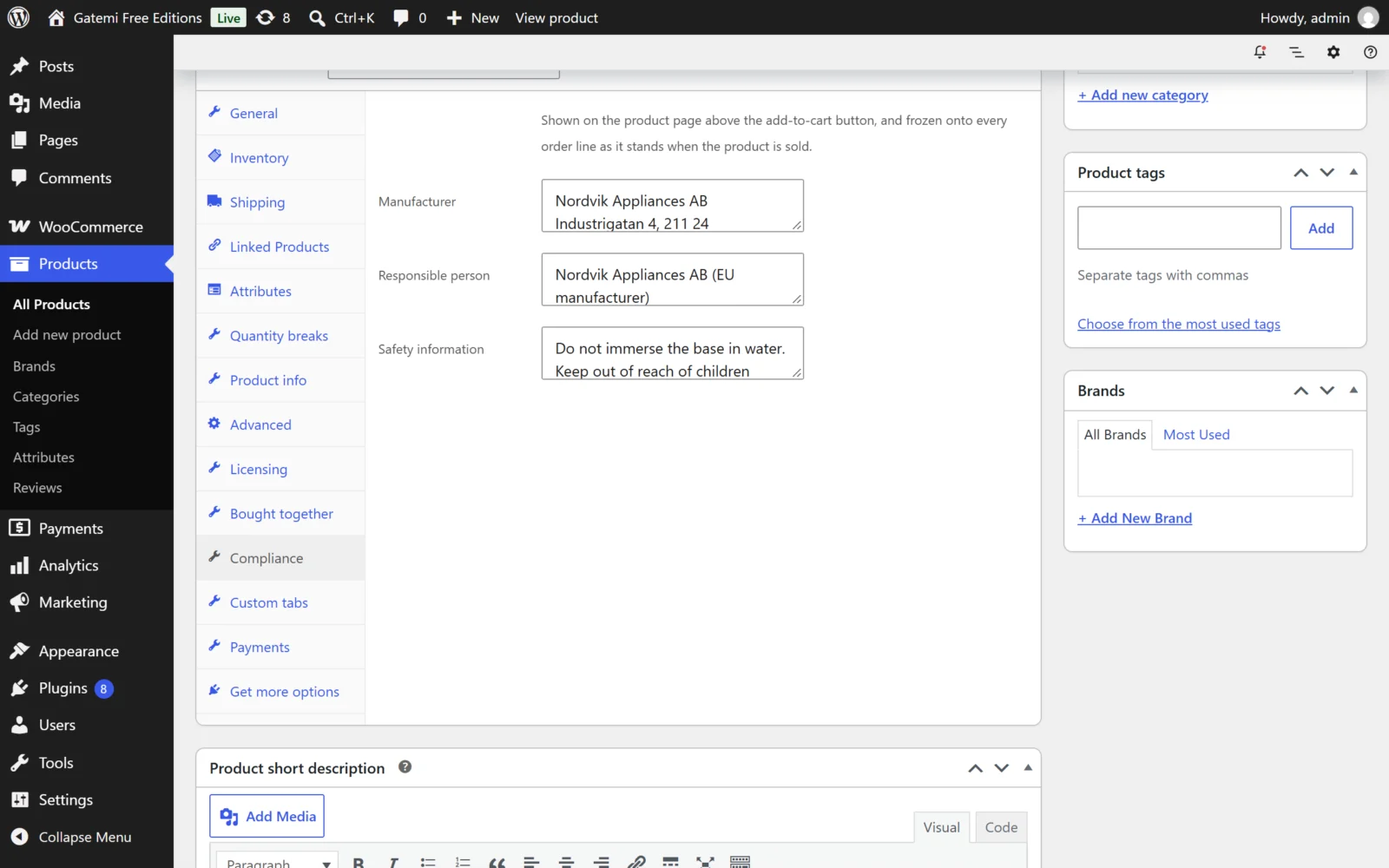
The fields are free text with line breaks, so an address can be typed the way it is printed: name, street, town, country, email.
Shown above the add-to-cart button
The declaration prints in the product summary — WooCommerce's woocommerce_single_product_summary hook at priority 25, which on a classic product page is after the short description and before the add-to-cart button at 30. It appears as a short "Product safety and compliance" list, with only the fields that have something in them. The full edition can also add a "Product safety" tab beside the description; the tab is an addition, never a replacement for the summary.
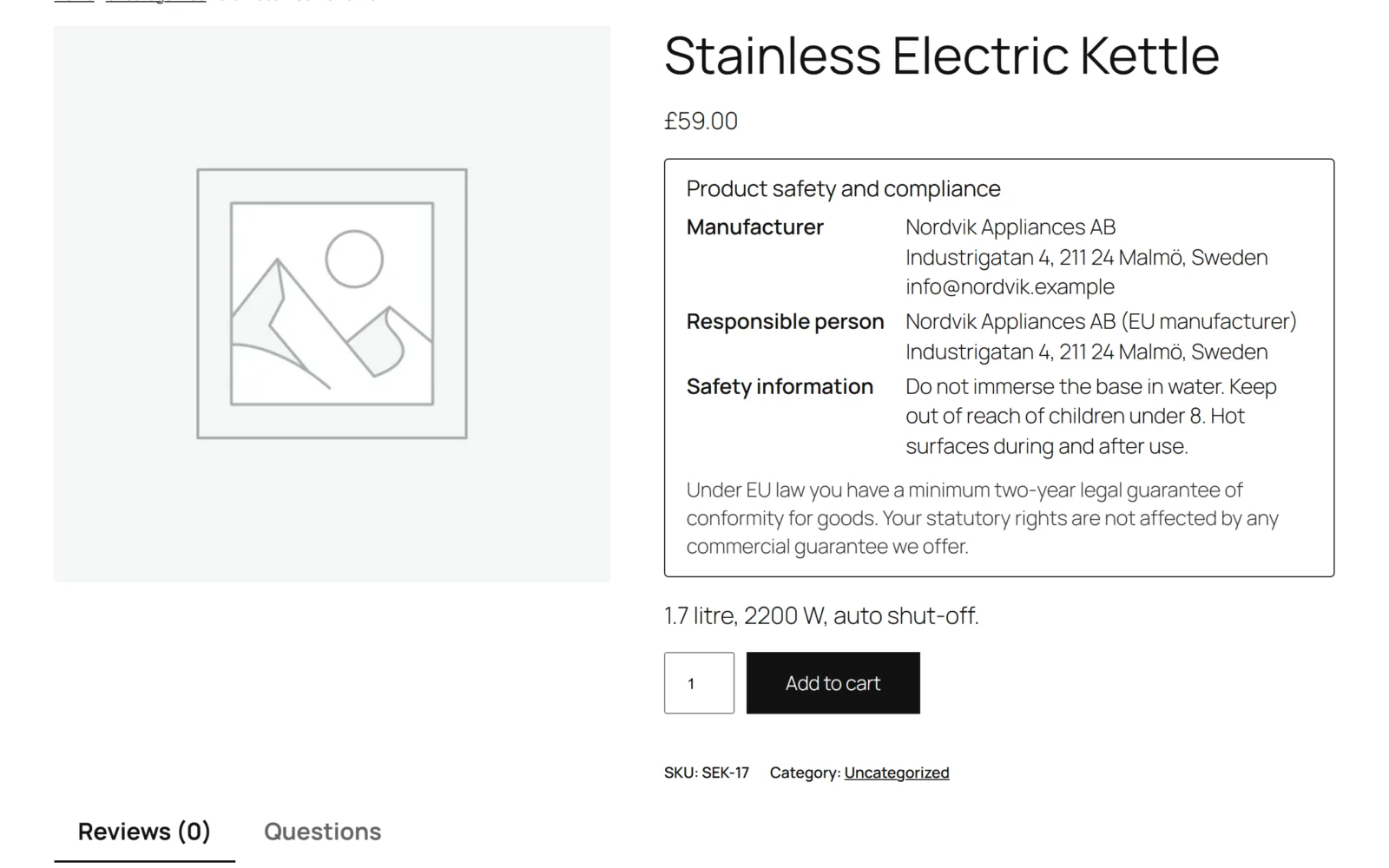
There is no JavaScript on the storefront, and the small stylesheet is only loaded on a page where a declaration was actually drawn.
Frozen onto every order line
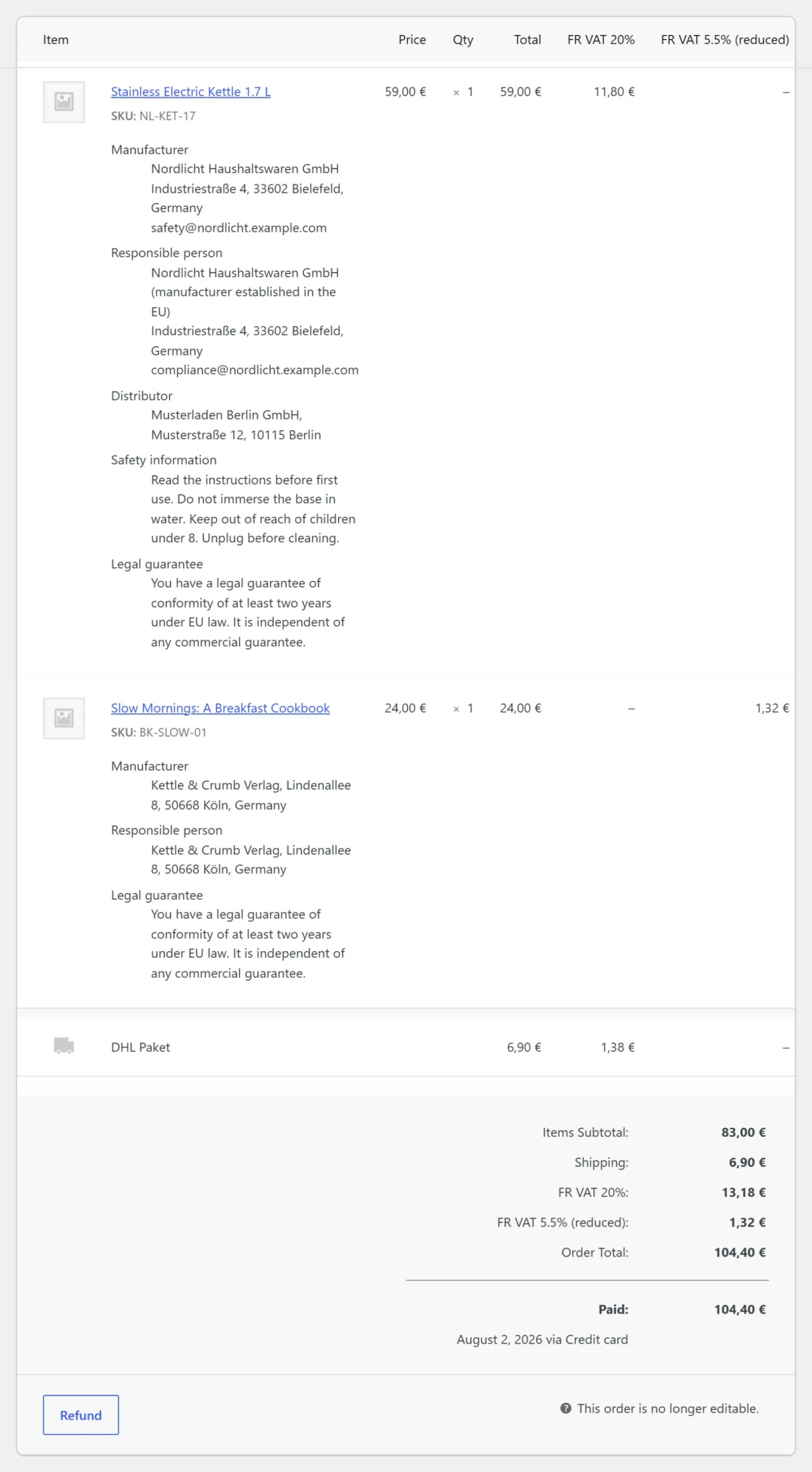
When an order is created — at the classic checkout or the block checkout — the declaration for each line is copied onto that order line as it stood at that moment. It is drawn back under the line on the admin order screen, on the order-received page, in My Account and in WooCommerce's order emails. Correct a manufacturer's address in August and an order from March still shows what that buyer was told in March.
A report of what is missing
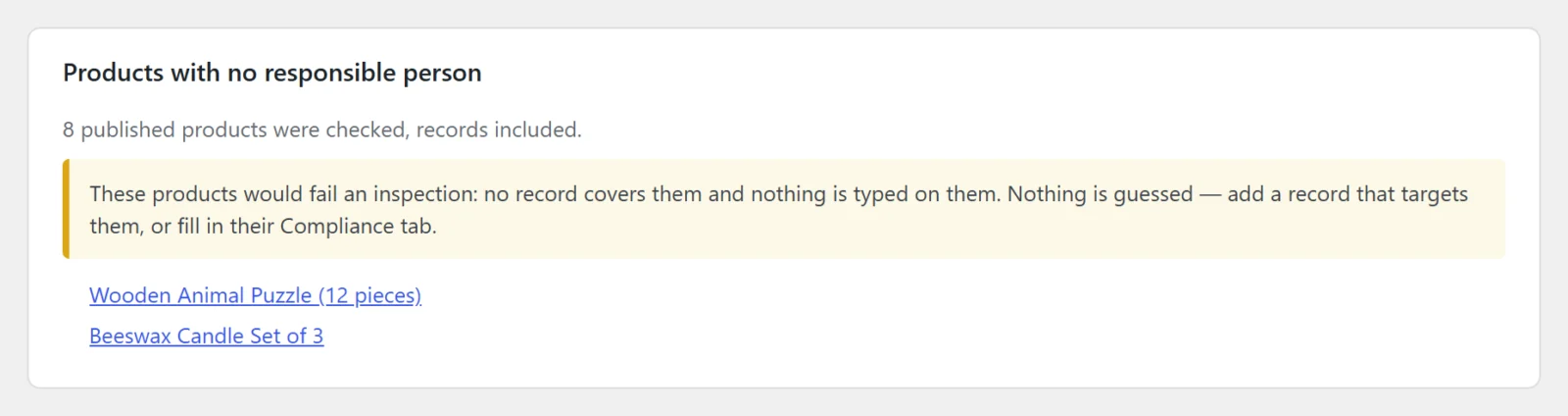
The settings screen (WooCommerce → Product Compliance) lists every published product that has no responsible person and no manufacturer established in the EU, by name, with a link to its editor. A product whose manufacturer's address ends in an EU member state is left out, because that manufacturer is itself the economic operator; the plugin reads the country from the last line of the address and, when it cannot tell, keeps the product listed. On the day you install it, every product is on the list — and that is the point: you see the work, not a reassuring green tick.
Full edition: records, markets and bulk import
A shop with three manufacturers and four hundred products should not type the same address four hundred times. The full edition adds compliance records: a record carries the six fields and says what it covers — every product, chosen products, or chosen categories including their sub-categories. A product's own Compliance tab still wins, field by field, so overriding the warnings on one product leaves the record's manufacturer and responsible person in force.
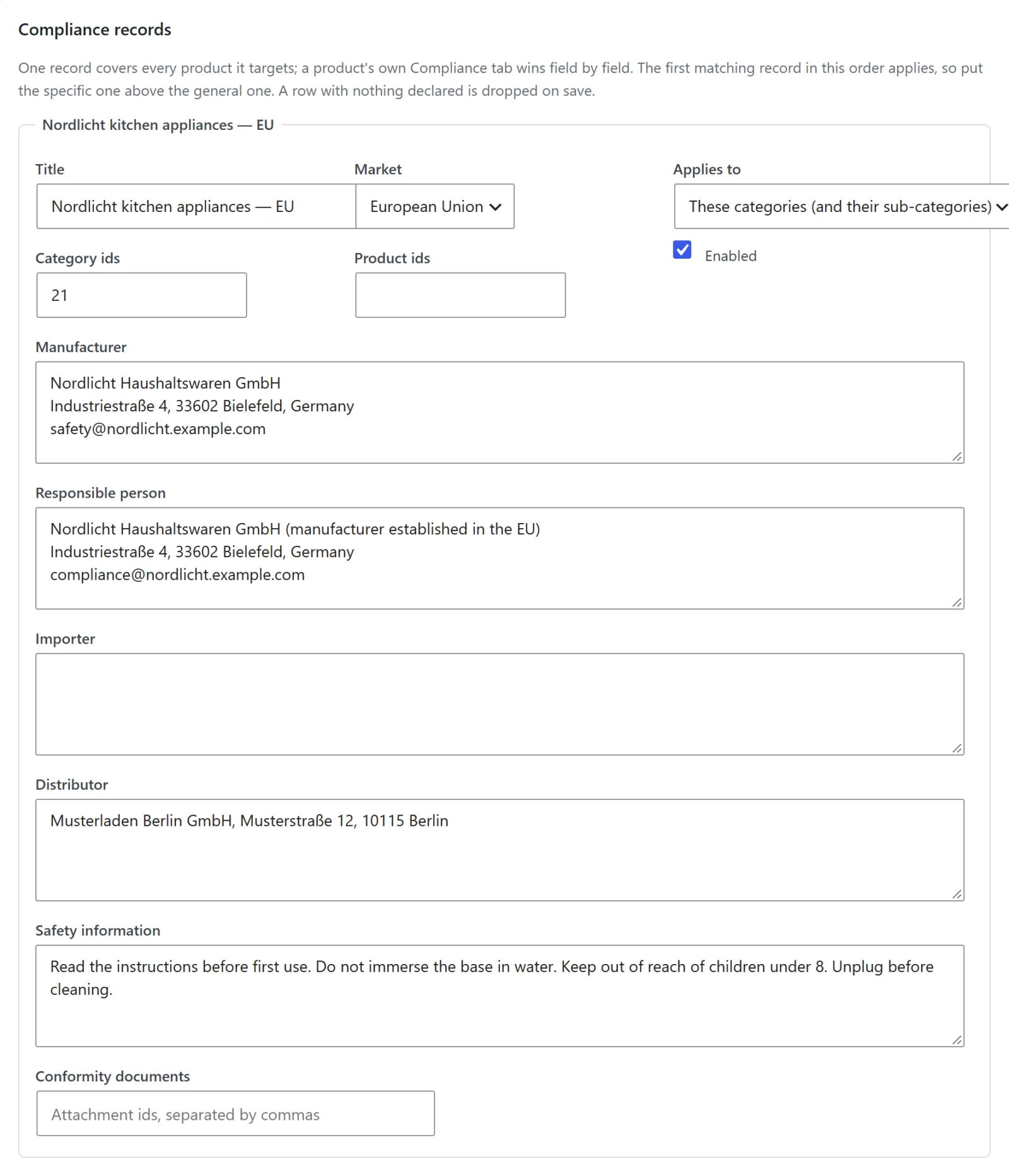
Records can be written for the EU, the UK or both. The shopper's market is read from their shipping country, then their billing country, then your store's own country; a shopper in Great Britain (GB) is shown UK records and anybody else EU records. That is how one shop can show an EU responsible person to a buyer in Dublin and a UK one to a buyer in Leeds.
And for catalogues that already live in a spreadsheet, the full edition imports declarations from a CSV file, matching products by SKU or product id, with a rehearsal mode that writes nothing and reports every problem by line number. See Getting hundreds of products GPSR-ready with a CSV import.
What it does not do
It does not check the information. It cannot tell whether your responsible person is properly appointed, whether your warnings are in the right language, or whether a product is safe. It displays what you declare, keeps a copy with each order, and tells you where something is missing. It makes no external requests for any of this — everything stays in your own database and media library.
A worked example
Puzzle Harbour is a small WooCommerce shop in Cork selling 340 wooden puzzles and toys. They come from three makers:
- Fjord Toys AS in Norway — outside the EU, sold to Puzzle Harbour through Holzwerk Import GmbH in Hamburg, which is the importer and therefore the responsible person;
- Atelier Bois SARL in Lyon — an EU manufacturer;
- a dozen one-off pieces made by a local craftsperson in Ireland.
With the full edition, the owner writes three records:
- Fjord Toys — applies to the "Fjord" category and its sub-categories; manufacturer is Fjord Toys AS with its Oslo postal address and support email; responsible person is Holzwerk Import GmbH, Hamburg, with its email; importer the same; safety information "Not suitable for children under 36 months. Small parts. Choking hazard."
- Atelier Bois — applies to the "Atelier Bois" category; manufacturer and responsible person both Atelier Bois SARL, Lyon.
- Local makers — applies to the twelve products by id; manufacturer and responsible person the Irish maker.
The report drops from 340 products to one: a puzzle that was filed in no category at all. Fixing its category clears the list. A year later Holzwerk moves offices; one record is edited and 220 product pages change. The orders from before the move still show the old address — which is what those buyers were shown.
With the free edition, the same shop types the three fields on each product, and the report lists the products still missing a responsible person until they are done.
Checklist
- Decide whether your offers are targeted at EU consumers (shipping countries, languages, currency).
- For each product line, identify the manufacturer and, where it is outside the EU, the EU responsible person — and get their postal and electronic addresses.
- Collect the warnings and safety information that come with each product, in the languages of the countries you sell to.
- Make sure each product page shows a picture, its type and an identifier.
- Put the manufacturer, responsible person and warnings on the product page itself, clearly and visibly.
- Keep a record of what each buyer was shown.
- From 27 September 2026, show the legal-guarantee harmonised notice as your national rules require.
A fuller version is in The GPSR checklist for WooCommerce shops.
Sources
- Regulation (EU) 2023/988 on general product safety — Articles 2, 4, 15, 16, 19, 22, 44 and 52.
- Regulation (EU) 2019/1020 on market surveillance — Article 4.
- Commission Guidelines C/2025/6233 on the application of the GPSR by businesses.
- Safety Gate — obligations for businesses.
- GOV.UK — General product safety regulations: Northern Ireland.
- Directive (EU) 2024/825 and Implementing Regulation (EU) 2025/1960 on the harmonised notice.
Next step
Start with the report: it tells you how far you are from having every product declared. See Gatemi Product Compliance for WooCommerce — records, EU and UK markets and CSV import for a whole catalogue — or wait for the free edition on wordpress.org if your catalogue is small enough to type by hand.